Skip to content

Service League: a landing page for a volunteering app

Landing page design and build for Service League, a gamified volunteering app: one desktop page with the hero, 3 reasons, 6 focus areas and 3 join steps.

Service League

The engagement

Client
Service League
Industry
Volunteering and community service
Year
To follow
Duration
To follow
Delivered
One desktop landing page in eight sections, hero to footer, built full stack
Stack
To follow
Role
Full-stack development: design and build of the landing page

Service League is a volunteering app that treats community service as a game: points, a world ranking and an avatar for the service a person gives. Plainbuilt designed and built its landing page full stack: one desktop page in eight sections, hero to footer, with a dotted world map under the headline, the founder's story, 3 reasons, 6 focus areas, 3 join steps and a contact block. One magenta accent on a near-black ground marks every action.

Who is Service League for?

People who want to do community service and want it to count. The page lists six causes (social impact, hospitals, homeless shelters, disaster relief, animal shelters, community outreach) and speaks to the volunteer, not the organization: customize an avatar, browse projects matched to your interests and location, earn points and a world ranking. The Our story section gives the founder's own path from fundraising campaigns to the app; the founder is not named on the page.

What did Plainbuilt build?

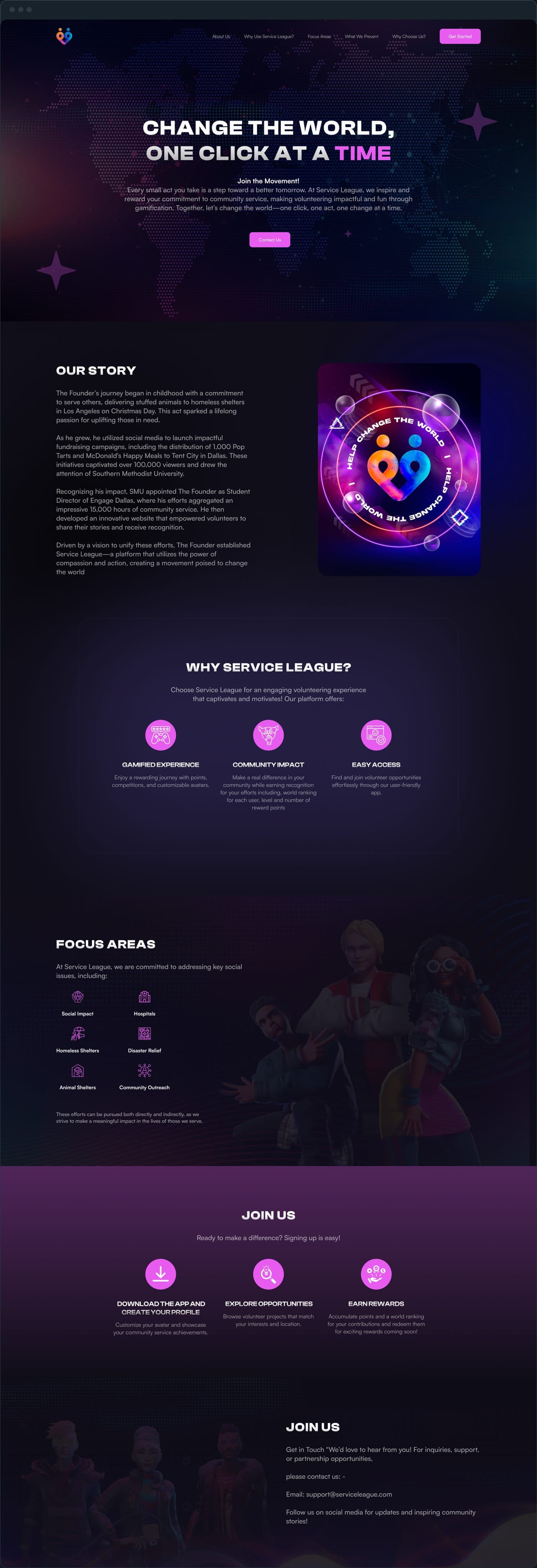
The landing page, full stack. The nav with five links and a Get Started button. The hero: the headline Change the world, one click at a time, the Join the movement lede and a Contact Us button over a dotted world map. The founder's story beside the circular Help change the world badge with the two-figure heart logo. The three reasons on magenta discs in a bordered card. The six focus areas with line icons beside the 3D avatar characters. The three join steps in the purple band. The contact block with the support email. Then the app band with two phone mockups, labeled Pick your service and Official world ranking, and the footer with the logo and the nav links again. The whole-page figure above runs from the hero to the contact block.

What does the join flow look like?

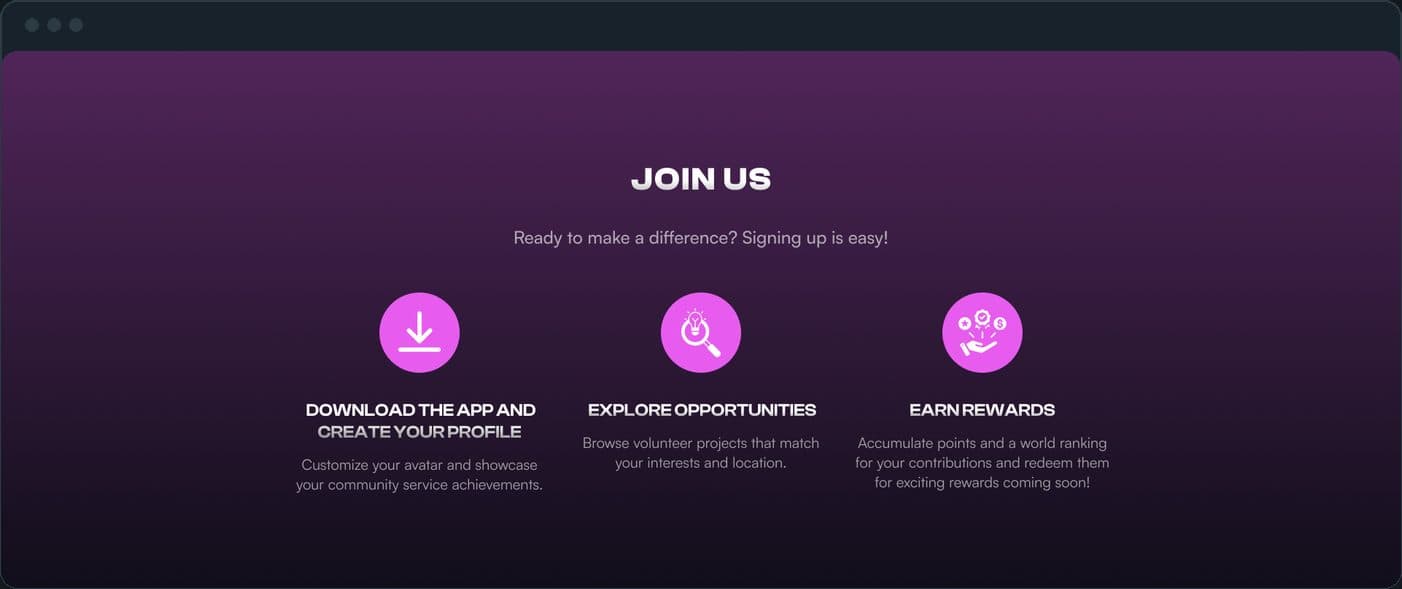
Three steps on magenta discs in the purple band. Download the app and create a profile: customize an avatar and show community service achievements. Explore opportunities: browse volunteer projects that match interests and location. Earn rewards: accumulate points and a world ranking, with redeeming points for rewards marked coming soon. The same three-disc row carries the three reasons higher up the page, so the two sections read as one system.

Why is everything dark except the magenta?

The ground is near-black, with purple bands for Join us and the footer. Magenta appears on the buttons, the icon discs and the one highlighted word in the headline, TIME. One accent on one dark ground means the eye goes to the action every time. The logo's own orange-to-blue heart mark stays in the nav, the badge and the footer.

What is Service League?

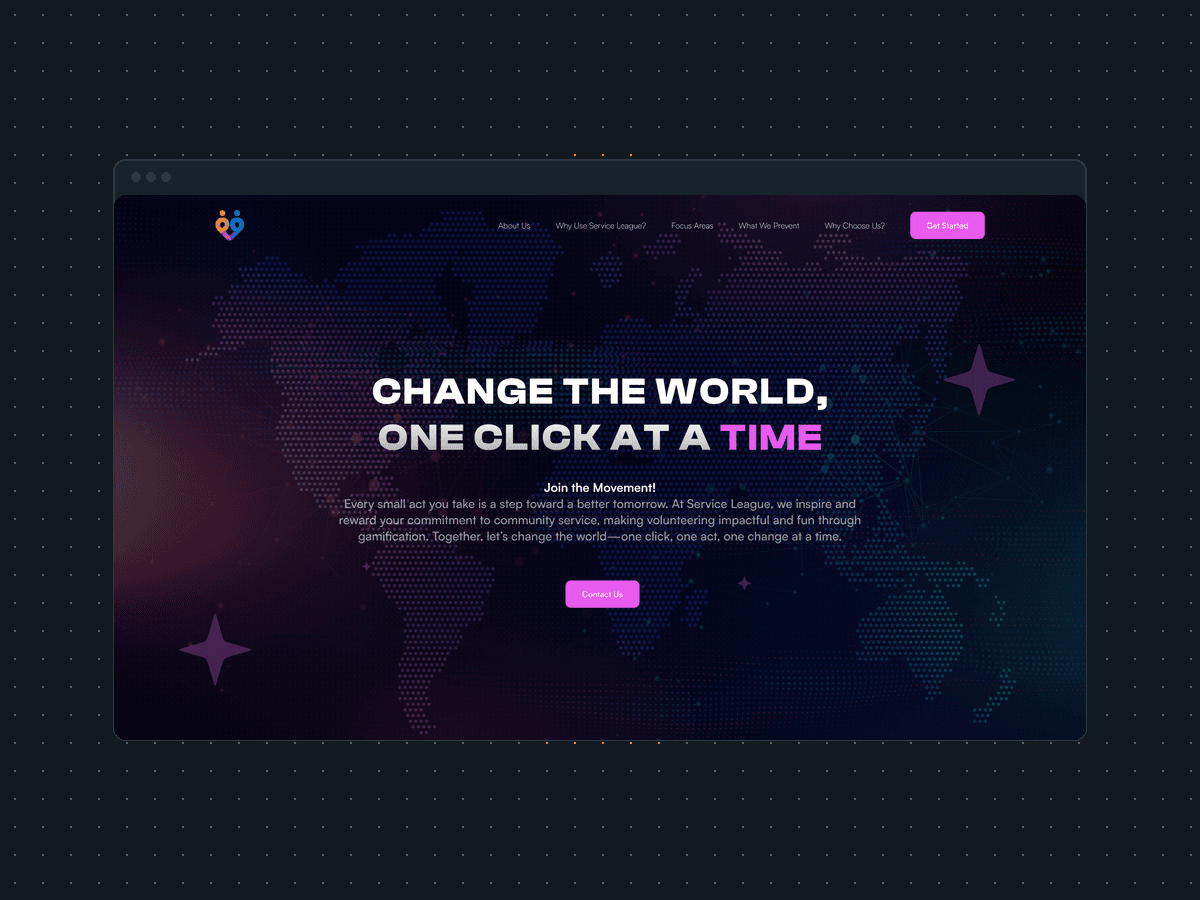
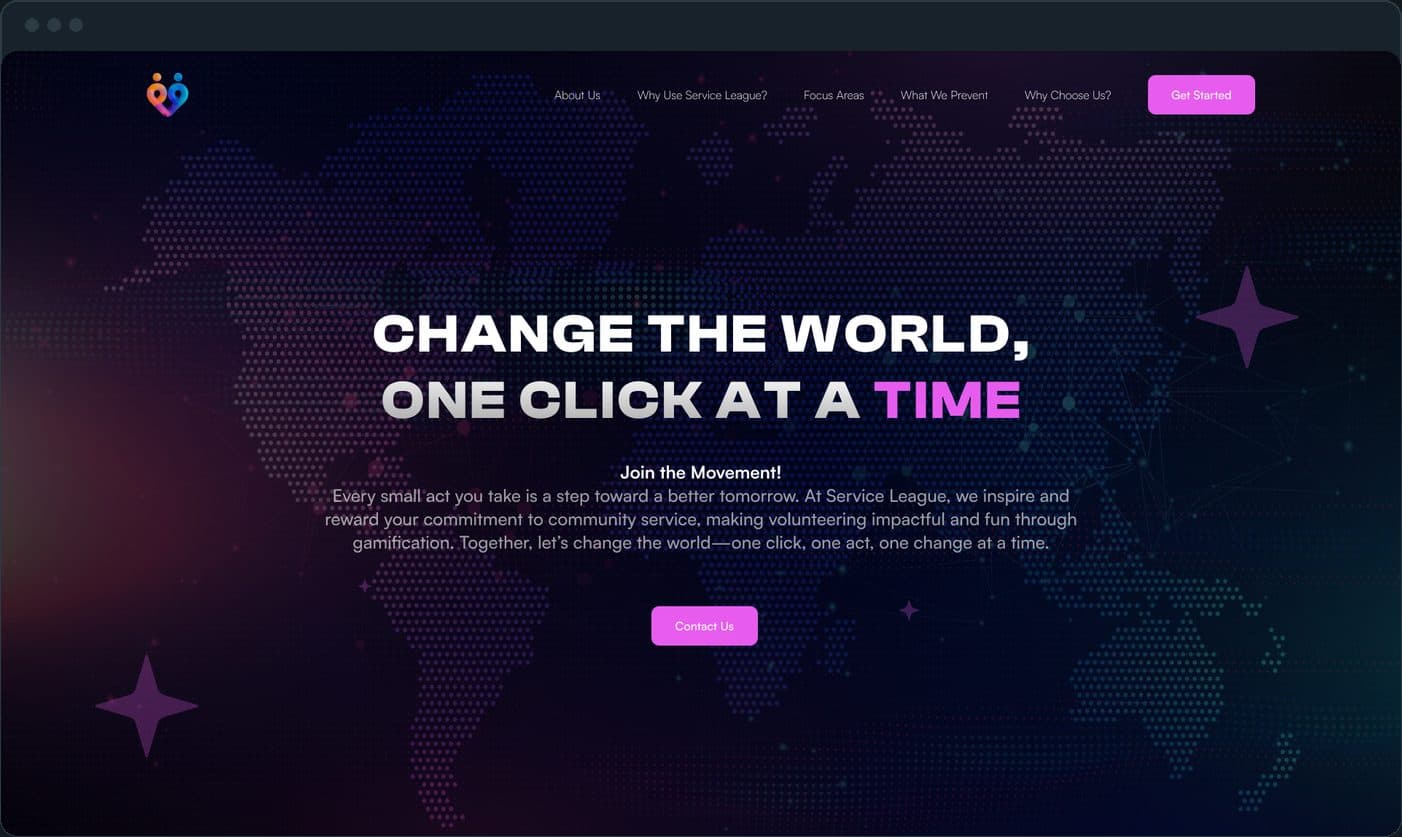
A volunteering app that treats community service as a game. The page opens with the headline Change the world, one click at a time, the lede Join the movement, and the app's own claim: it inspires and rewards commitment to community service, making volunteering impactful and fun through gamification. One Contact Us button under the copy, one Get Started button in the nav, a dotted world map behind.
Service League: What is Service League?

Why would someone use it?

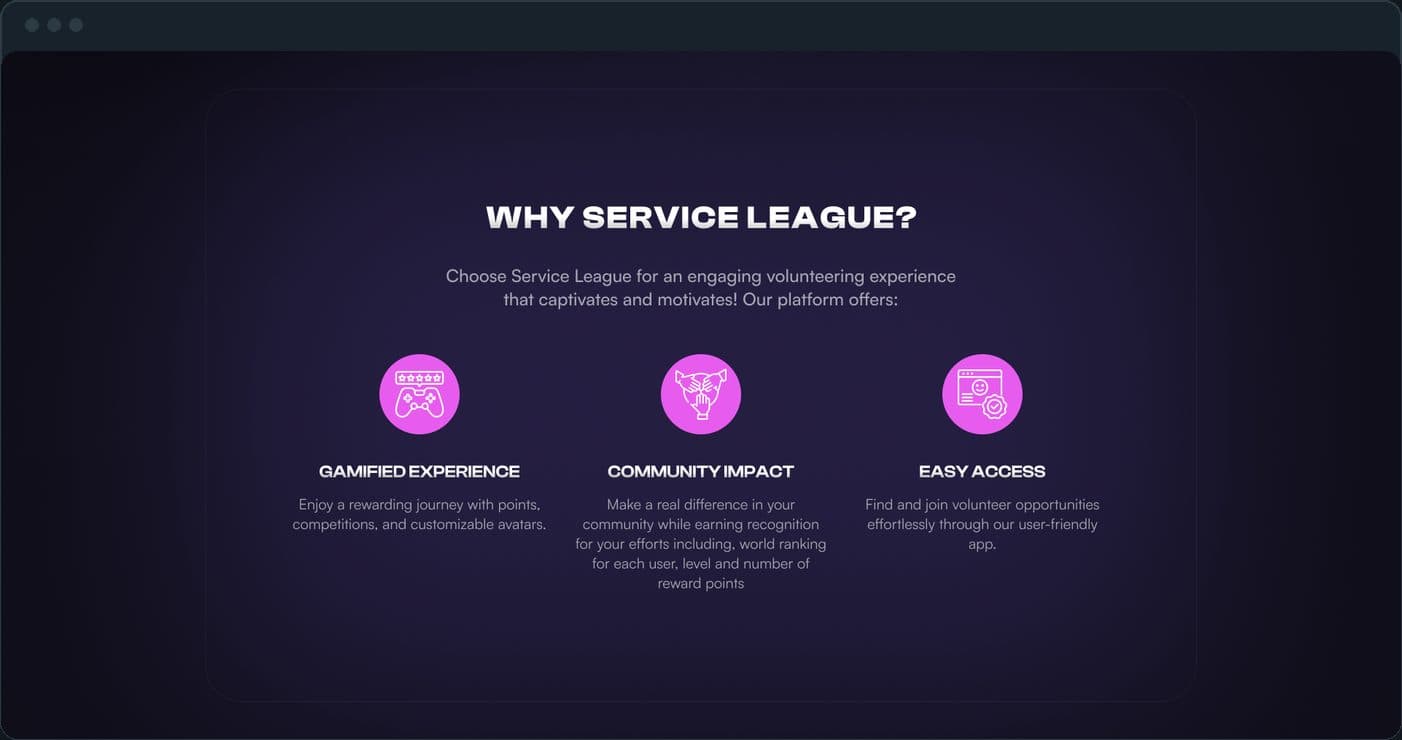
The page gives three reasons on magenta discs: a gamified experience with points, competitions and customizable avatars; community impact, with a world ranking, a level and reward points for each person; and easy access to volunteer opportunities in the app. Three reasons, a short line each, in one bordered card on the dark ground.

Service League: Why would someone use it?

How does a person join?

Three steps in the purple band: download the app and create a profile (customize an avatar, show community service achievements), explore opportunities (browse volunteer projects matched to interests and location), and earn rewards (points and a world ranking; redeeming points for rewards is marked coming soon). The steps sit on the same magenta discs as the reasons above them.

Service League: How does a person join?

What does the page say, top to bottom?

After the hero: the founder's story beside a circular Help change the world badge with the two-figure heart logo; the three reasons; six focus areas (social impact, hospitals, homeless shelters, disaster relief, animal shelters, community outreach) beside 3D avatar characters; the join steps; then the contact block with the support email. The figure runs from the hero to the contact block; the app band and the footer follow it.

Service League: What does the page say, top to bottom?

The decisions

  • One accent, every action.

    Magenta sits on the buttons, the icon discs and the one highlighted word in the headline. Everything else is near-black or purple, so the action is the brightest thing on every screen.

  • The world is under the headline.

    A dotted world map fills the hero. The app ranks volunteers on a world leaderboard, and the first screen shows the world before the page explains the app.

  • Reasons and steps share one row.

    Three magenta discs, a bold label and a short line, used twice: for the three reasons and for the three join steps. Two sections, one pattern, nothing to relearn.

  • The causes are named.

    The focus areas are six named causes with a line icon each, in two columns, not a paragraph about impact. Someone who cares about animal shelters finds the word in one look.

What was the outcome?

Designed and built

One outcome per item, dated, or not disclosed: never an estimate.

Common questions

Did Plainbuilt build Service League?

Yes. Plainbuilt designed and built the site. This item is the landing page; the app it presents is Service League's product.

What is Service League?

A volunteering app that treats community service as a game: a person builds an avatar profile, picks volunteer projects matched to their interests and location, and earns points and a world ranking for the community service they do. The landing page is the web side of it.

Can Plainbuilt design a landing page for an app?

Yes. One page that says what the app does in the first screen, gives the reasons, shows how to join in steps and ends in a contact block. Book a working session and bring the app.