Skip to content

Keep Me Posted EU: a consumer campaign website

Website design and build for Keep Me Posted EU, a consumer campaign: 21 pages, desktop and phone layouts, 19 fact cards, 10 country law pages, a register form.

Keep Me Posted EU

The engagement

Client
Keep Me Posted EU
Industry
Consumer advocacy
Year
To follow
Duration
To follow
Delivered
21 pages, desktop and phone layouts: home, the campaign, get the facts, 10 country pages, take action now, supporters, community, contact; built full stack
Stack
To follow
Role
Full-stack development: design and build of the website

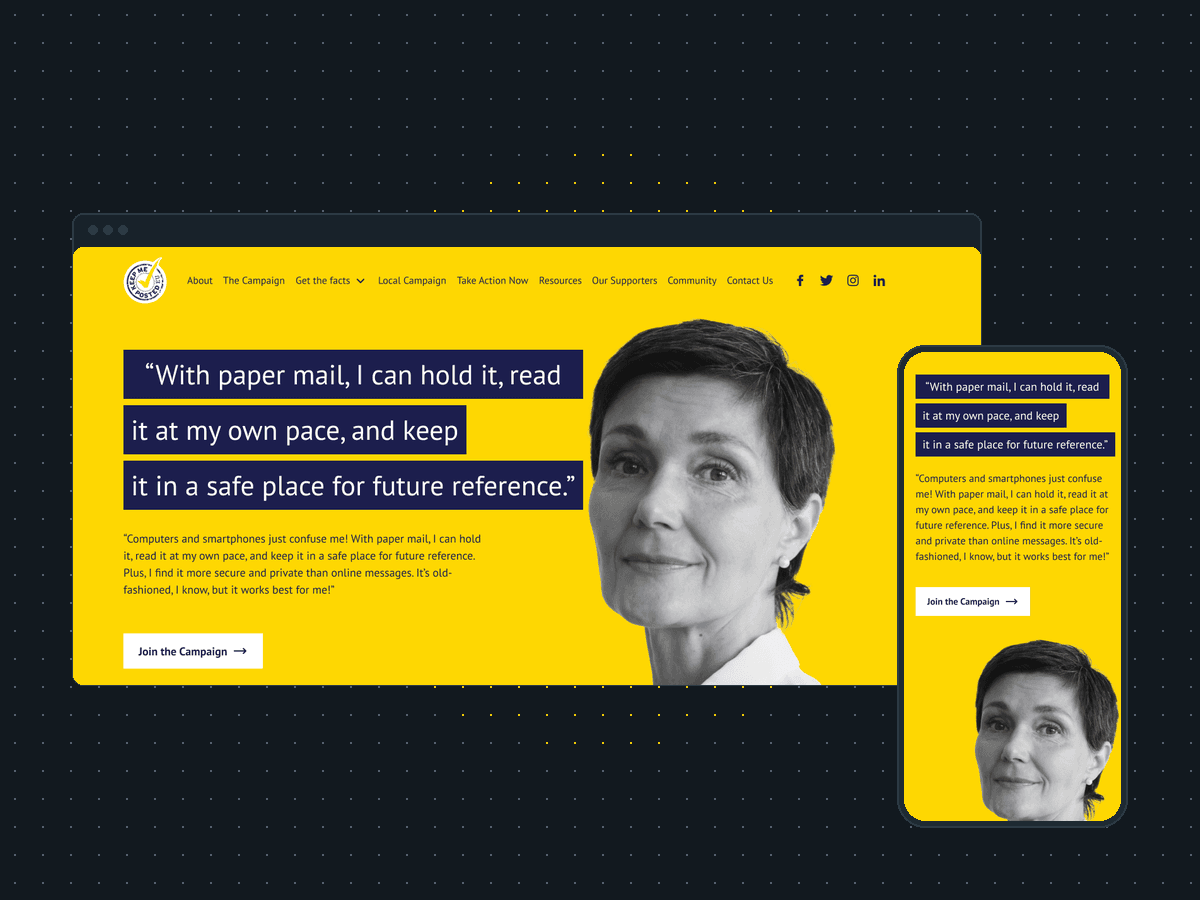
Keep Me Posted EU is a consumer campaign for the citizen's right to choose how they receive important information, paper or digital, without penalty. Plainbuilt designed and built its website full stack: 21 pages with desktop and phone layouts, a home page that opens on a citizen's quote, a grid of 19 fact cards, 10 country pages on the law in each country, and a register form for supporters, all on the campaign's yellow, navy and black.

Who is Keep Me Posted EU for?

People who need paper. The citizens quoted on the site say computers and smartphones confuse them, that paper mail can be held, read at their own pace and kept in a safe place, and that a small business relies on physical mail for record-keeping. The site speaks to them, to the companies and banks that send the bills, and to the lawmakers listed on its Our Supporters page.

What was the problem?

The campaign's own About copy states the job: put the personal stories of people who risk isolation without access to postal services at the front, and redesign the site around them. The site had to carry three things at once, the stories, the numbers behind the argument and the legal position in each country, and get a visitor from any of them to the register form.

What did Plainbuilt build?

The website, full stack, in 21 pages: home, about, the campaign, get the facts and one fact page, local campaign, take action now, resources, the community and advocacy forum, our supporters and contact, plus 10 country pages in one order, with phone layouts across the site. The black footer with the Pick a Country flag row closes every page; the home page adds a Become a Supporter band and a newsletter sign-up before it, and the fact page and Take Action Now carry the newsletter band too. The home page carries a Stories block and the latest news; the community page carries a stream block with a news carousel and four headlines beside it. The Join the Campaign button sits in the hero and on every campaign card; Take Action Now is the page with the form.

Why do the country pages run in one order?

Ten countries, one order: Recent Developments, the flag beside the legal column, Information and links, Campaigns. The Germany page quotes the Federal Court of Justice decision of 9 October 2014 that a fee for a paper bill is unlawful; the Austria page quotes the Supreme Court decision of 17 July 2014 and links two national campaigns. Where a country has no national campaign, the section says so in one line, and a part a country has nothing for drops out. A visitor who has read one country can read the next without relearning the page.

What does the home page say first?

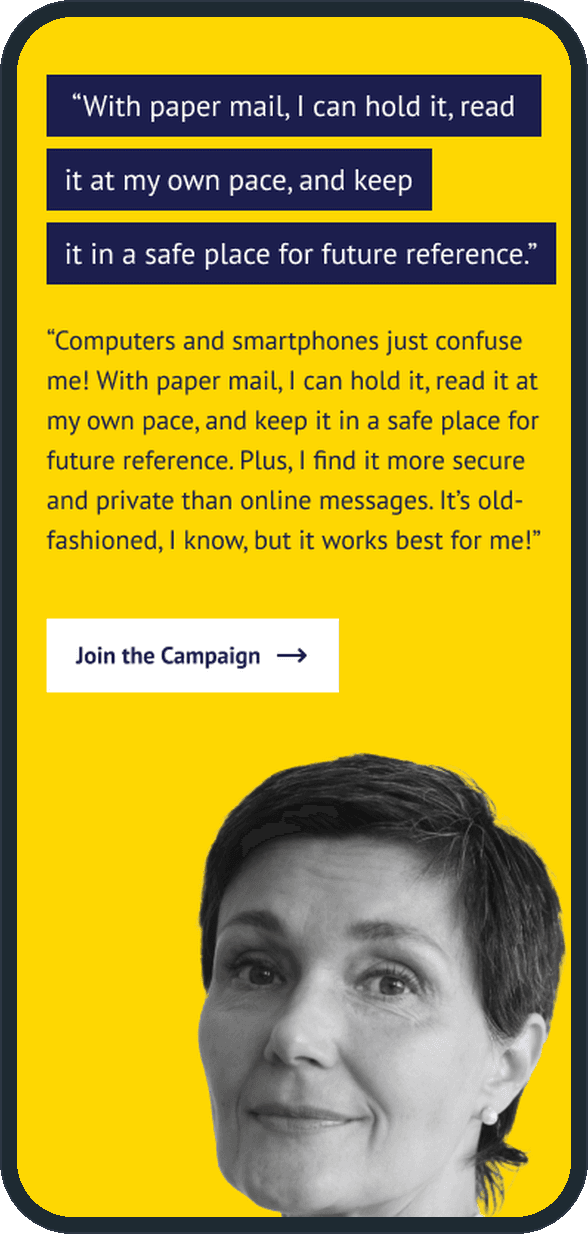
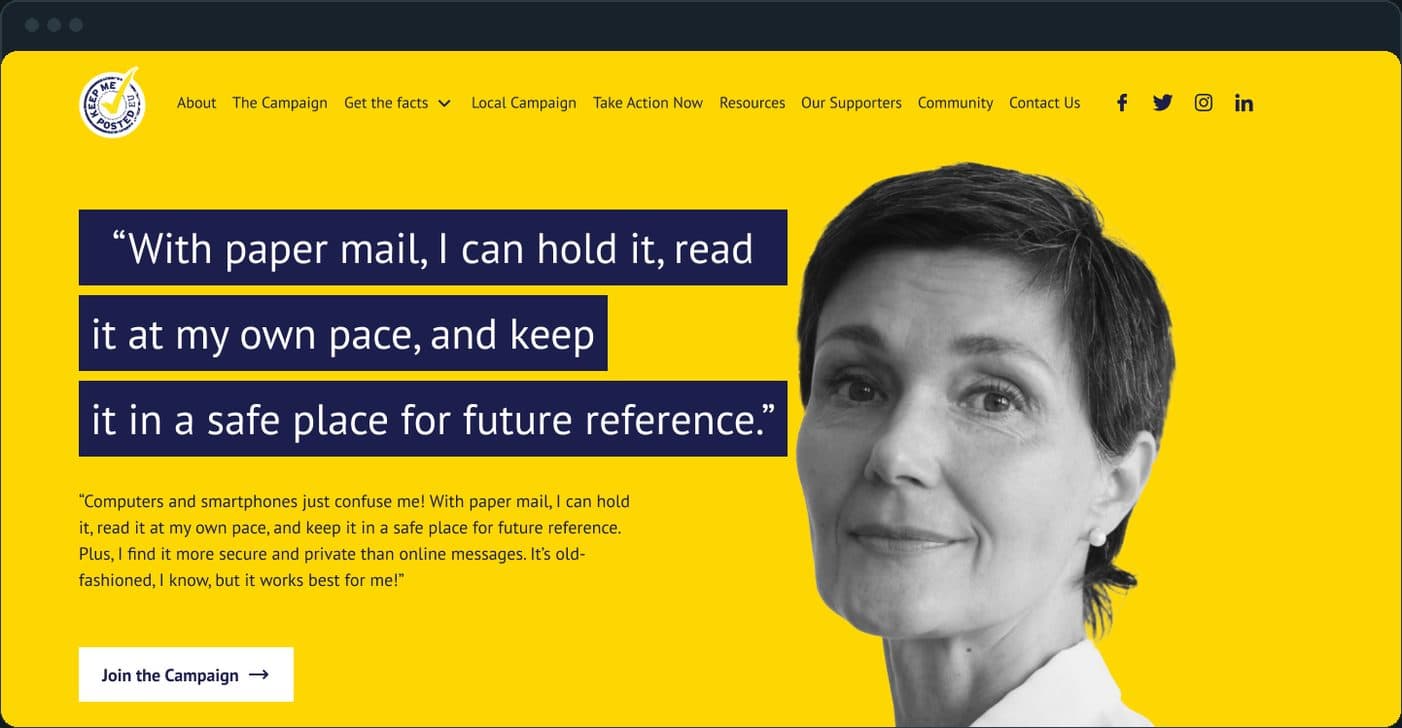
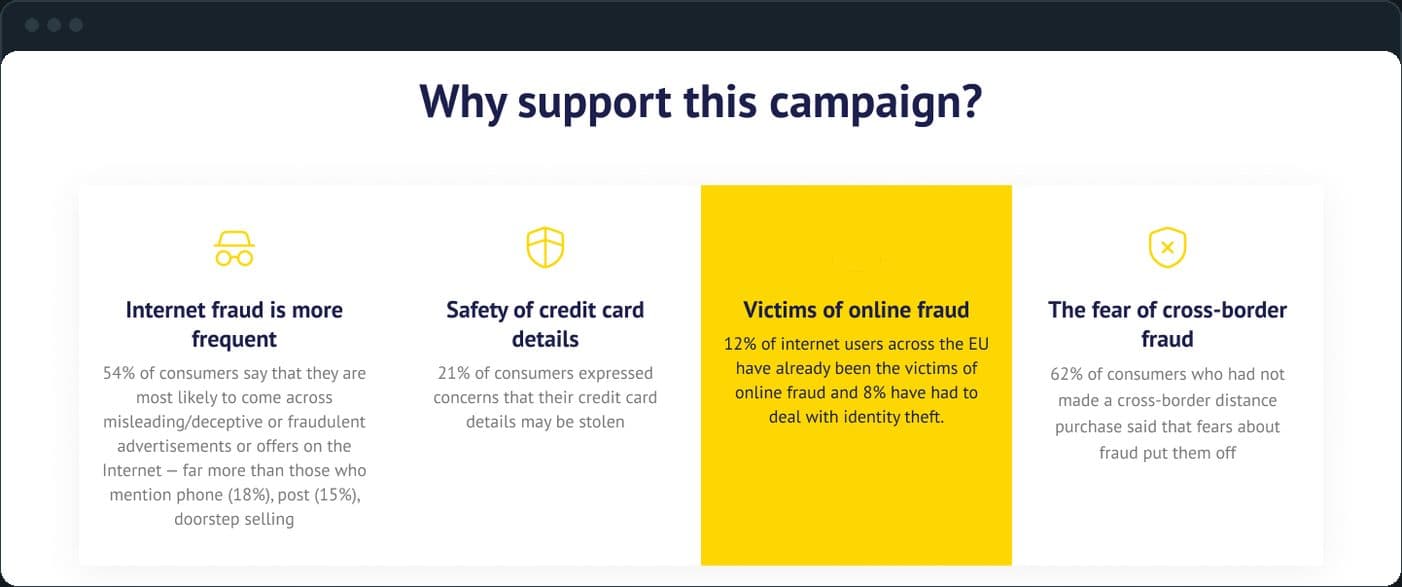
A citizen's quote, three lines on navy blocks over the campaign yellow: with paper mail, I can hold it, read it at my own pace, and keep it in a safe place for future reference. Her portrait sits beside it and the Join the Campaign button under it. Then Why support this campaign? answers with four cards, one statistic each: 54% of consumers meet misleading advertisements most often on the internet, 21% worry about their card details, 12% of people online across the EU have been victims of online fraud, 62% were put off a cross-border purchase by the fear of fraud.
  • Keep Me Posted EU: What does the home page say first?
  • Keep Me Posted EU: What does the home page say first?

What does the campaign ask for?

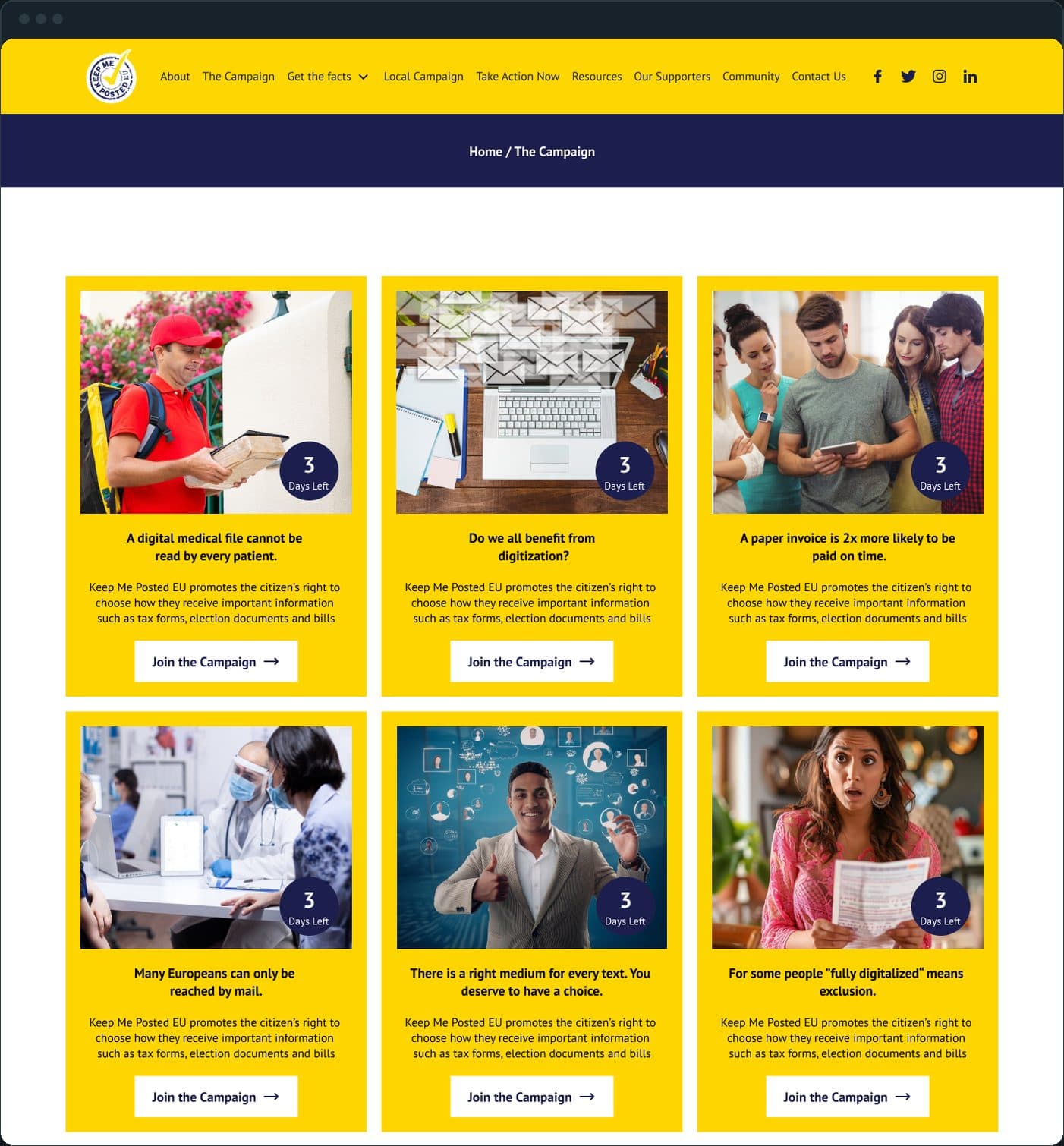
Six yellow statement cards carry the argument one line each: many Europeans can only be reached by mail; there is a right medium for every text, you deserve to have a choice; a paper invoice is 2x more likely to be paid on time. Every card repeats the one-sentence mission, that Keep Me Posted EU promotes the citizen's right to choose how they receive important information such as tax forms, election documents and bills, and ends in a Join the Campaign button.

Keep Me Posted EU: What does the campaign ask for?

Where do the numbers come from?

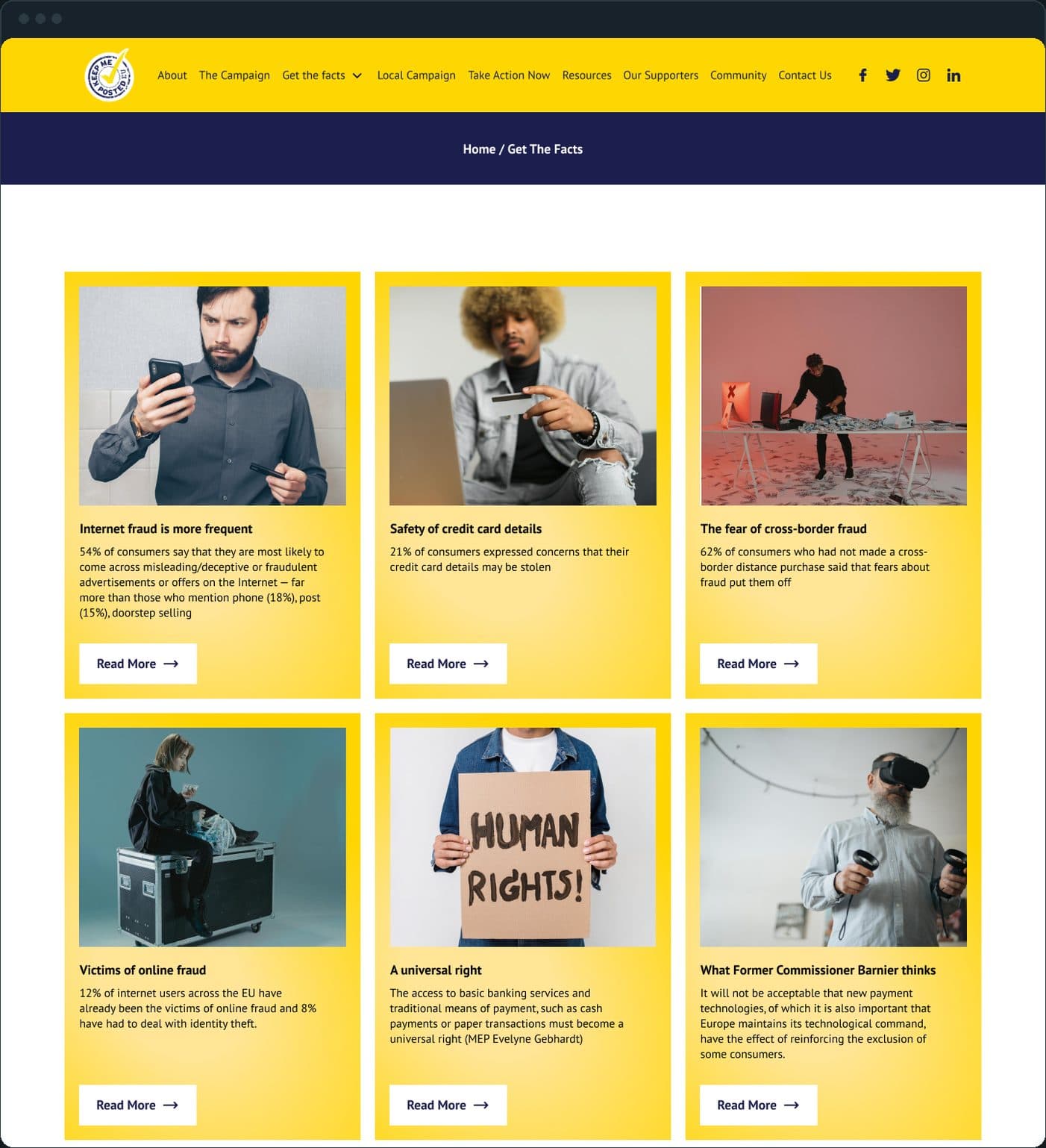
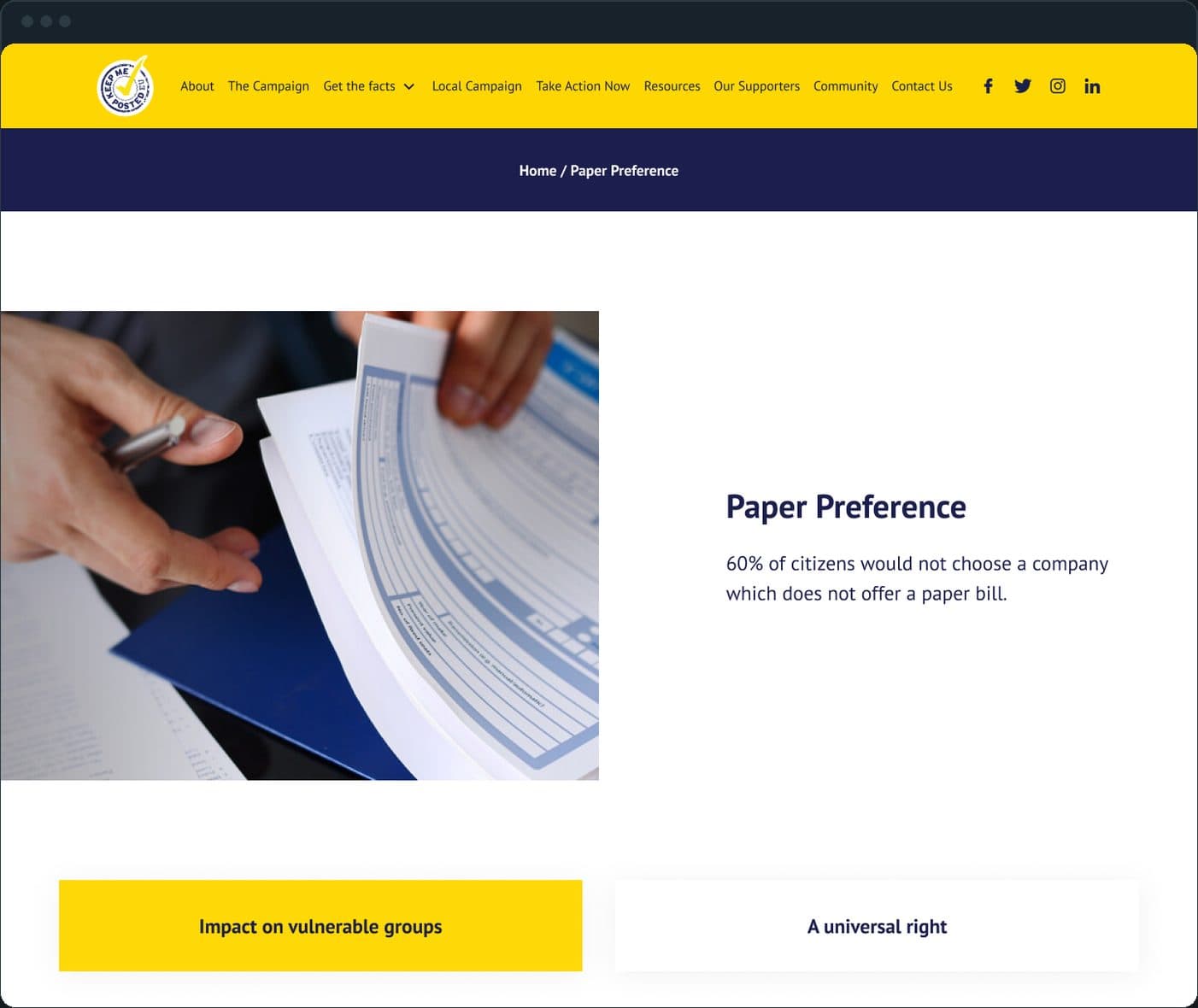
Get the facts is a grid of 19 cards, each a photo, a heading, one fact and a Read More link; most of the facts are a number. Read More opens the fact's own page, such as Paper Preference: 60% of citizens would not choose a company which does not offer a paper bill, with two related topics as tabs under it. A visitor reads one fact at a time; the detail sits one click down.

  • Keep Me Posted EU: Where do the numbers come from?
  • Keep Me Posted EU: Where do the numbers come from?

What is the law in each country?

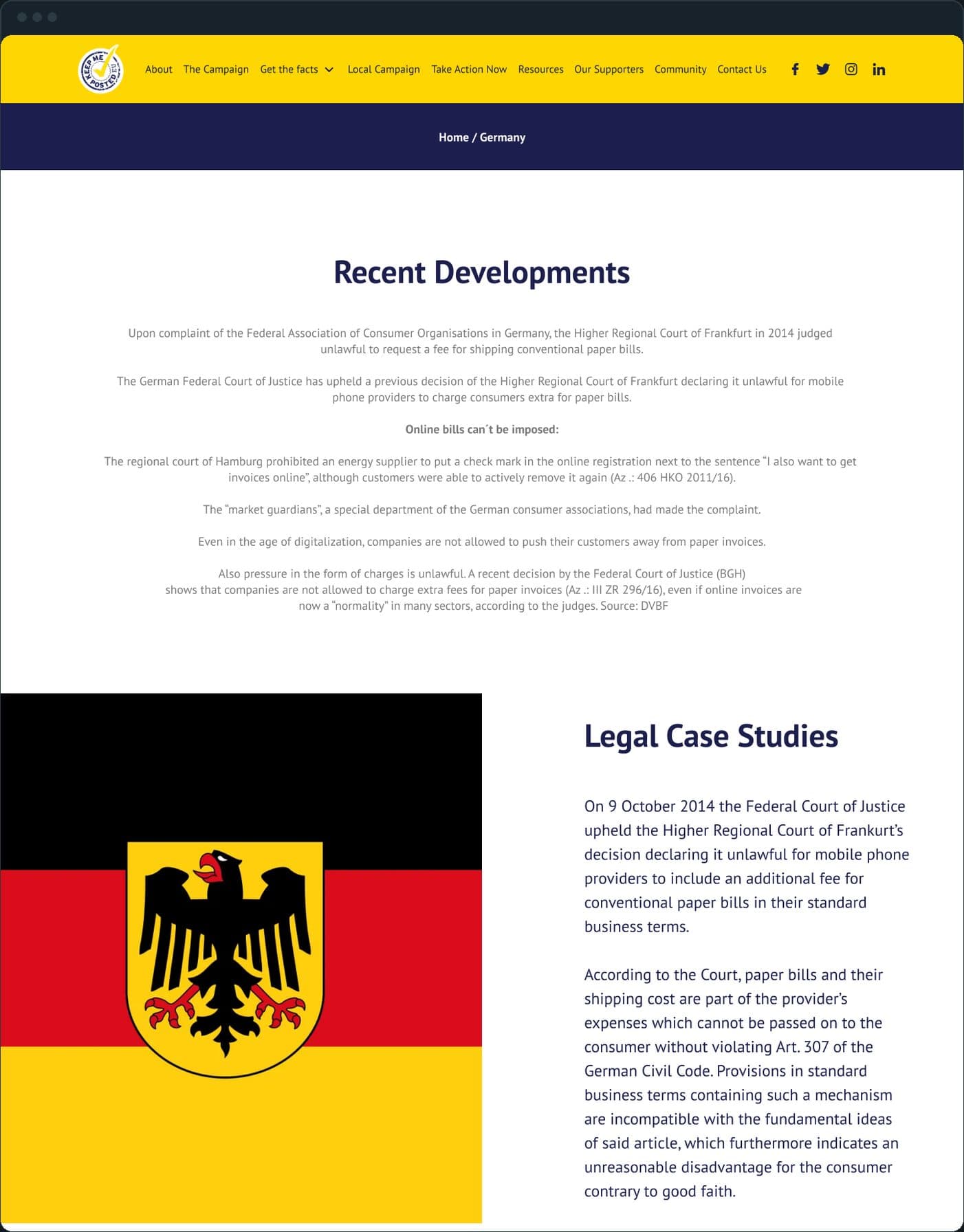
Ten country pages (Austria, Belgium, Finland, France, Germany, Ireland, Portugal, Slovenia, Spain and the United Kingdom) run in one order: Recent Developments at the top, the flag beside Legal Case Studies quoting the court decision (Germany: the Federal Court of Justice, 9 October 2014, a fee for a paper bill unlawful), an Information and links list with yellow check marks, and a Campaigns section. Where a country has no links or no national campaign, the section says so in one line or drops out. The footer's Pick a Country flag row reaches every one of them from every page.

Keep Me Posted EU: What is the law in each country?

How does someone join?

Take Action Now lists six ways to support: become an official supporter, support local initiatives, register for updates, share your story, tell your service provider or bank, download the leaflet. Then the register form: first and last name, business name, gender, country, your views, two consent boxes (one to share the story with the media, one for the campaign's statement) and Send Now. Below the form the page closes with the newsletter band and the footer.

Keep Me Posted EU: How does someone join?

The decisions

  • A citizen's words open the site.

    The hero is a quote on navy blocks over the campaign yellow, with the person's portrait beside it, not a slogan. The campaign is about people who need paper, so the page opens with one of them.

  • One fact per card.

    The four home cards each carry one statistic; the 19 fact cards each carry one fact and a Read More link. A visitor reads one fact at a time; the detail sits one click down on the fact's own page.

  • One order for ten countries.

    Every country page runs Recent Developments, the flag beside the legal column, Information and links, Campaigns, and a part a country has nothing for drops out. Adding a country means filling the parts, not drawing a page, and the footer's flag row is the map.

  • Two colors do the work.

    The campaign yellow carries the nav, the cards and the bands; navy carries the hero quote, the breadcrumb bar and the Become a Supporter band; the footer is black. The rest is white page, photos and flags.

What was the outcome?

Designed and built

One outcome per item, dated, or not disclosed: never an estimate.

More screens

  • Keep Me Posted EU

Common questions

Did Plainbuilt build Keep Me Posted EU?

Yes. Plainbuilt designed and built the site, full stack: the 21 pages, the fact cards, the country pages and the register form.

What is Keep Me Posted EU?

A consumer campaign promoting the citizen's right to choose how they want to receive information, without penalty: paper or digital, for tax forms, election documents and bills. The website is where a visitor reads the facts, checks the law in their country and registers as a supporter.